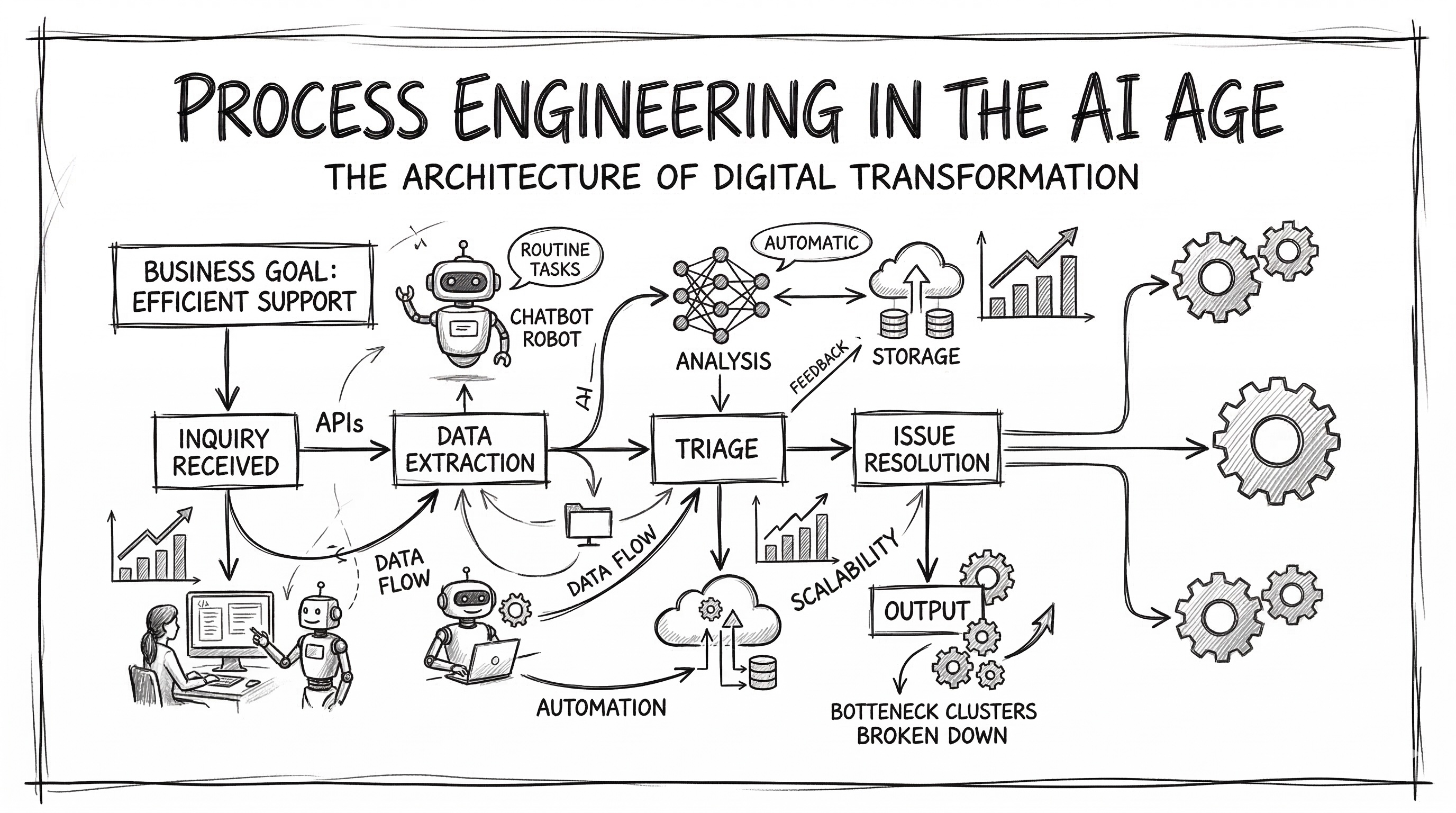
Introduction: the strategic imperative of process orchestration
In the contemporary technological landscape, Process Engineering has undergone a fundamental paradigm shift. No longer confined to the optimization of physical manufacturing lines or legacy ERP implementations, it has emerged as the architectural backbone of the modern digital enterprise. As global organizations face existential pressure to integrate Artificial Intelligence (AI) to maintain competitive parity and avoid technological obsolescence, the ability to map, deconstruct, and re-engineer workflows has become the primary determinant of institutional scalability.
The current climate is defined by a frantic search for "technology readiness," yet the most significant barrier remains the structural misalignment between sophisticated computational power and legacy organizational logic. This friction often leads to a superficial automation trap, where cutting-edge tools are layered over antiquated workflows, resulting in minimal ROI and increased operational complexity.
The fallacy of disaggregated productivity
A persistent fallacy in modern management theory is the assumption that individual labor productivity is linearly correlated with organizational velocity. The democratization of Large Language Models (LLMs) and Generative AI tools has enabled significant "local optima", individual employees can now produce content, code, or analysis at unprecedented speeds. However, as noted in the modern interpretation of the Solow Productivity Paradox, these gains often fail to transcend the individual level.
When the underlying processes are siloed or inefficient, technology often serves only to accelerate the production of "digital noise." For example, an AI that speeds up email drafting does not solve a bottleneck caused by a flawed approval hierarchy. True organizational productivity, therefore, is an emergent property of the system as a whole ($P_{org} \neq \sum P_{ind}$), requiring a transition from task-based automation to end-to-end process orchestration.
This disconnect is further highlighted by the emergence of a thriving "Shadow AI Economy." While only 40% of companies have purchased official LLM subscriptions, workers from over 90% of surveyed companies reported regular use of personal AI tools for work tasks. This demonstrates that while individuals have successfully crossed the divide through flexible, personal tools, official enterprise initiatives frequently remain stalled in the pilot phase.
The GenAI divide: beyond the "Plug-and-Play" paradigm
The prevailing market sentiment often treats AI as a "plug-and-play" utility; however, academic consensus suggests that measurable value is only derived when these systems are anchored to robust, domain-specific business logic. A critical challenge in this transition is the "transparency gap", where organizations struggle to identify which specific processes require AI and fail to visualize the real ROI of these solutions. When technology is deployed without clear process identification, the results often become "blurry," leading to explainability challenges and a breakdown in institutional trust.
Recent research from MIT’s Project NANDA identifies this phenomenon as the "GenAI Divide". Despite an estimated $30–40 billion in enterprise investment, approximately 95% of organizations are currently seeing zero return on their pilots. While generic tools like ChatGPT are widely used, enterprise-grade systems are being rejected because they are often brittle, lack contextual memory, and are misaligned with actual daily workflows.
To cross this divide, Process Engineering provides the necessary technical roadmap:
- Outcome-Based Customization: Successful buyers demand systems that integrate with existing processes and improve over time through business-outcome evaluation rather than software benchmarks.
- Back-Office Focus: While approximately 50% of budgets are typically directed to Sales and Marketing, the highest ROI is often found in back-office functions—such as operations, finance, and procurement—where learning-capable systems can replace expensive outsourced services (BPOs).
- The Implementation Advantage: Strategic external partnerships have been found to be twice as likely to reach full deployment (67%) compared to purely internal "build" efforts (33%), which often fail due to integration complexity.
The rise of the hybrid professional: the process architect
The complexity of modern digital workflows necessitates the rise of a "hybrid professional"—the Process Architect—capable of navigating the intersection of business strategy and technical implementation. This role demands fluency in data orchestration, model governance, and the technical constraints of the current AI stack.
These "translators" are responsible for converting strategic intent into concrete, scalable technical protocols. The MIT research highlights that the strongest enterprise deployments often begin with "prosumer" employees, power users who already use AI privately and understand how to guide the technology to meet specific workflow needs. By decentralizing implementation authority to these domain experts while maintaining executive accountability, organizations can ensure that AI solutions provide actual operational fit rather than remaining isolated "science projects".
Toward autonomous coordination: the future of deep integration
The trajectory of digital transformation points toward a future that is significantly more technological and autonomous than the current landscape. However, a critical lesson from the initial wave of AI adoption is that technology alone cannot catalyze organizational change; it only becomes a lever for transformation when it is deeply integrated into the specific processes and business logic of the firm. For a company to be future-ready, it must move beyond viewing software as a collection of siloed tools and start viewing it as a coordinated nervous system.
The next evolution involves an environment where autonomous systems with persistent memory and iterative learning coordinate across the entire internet infrastructure. This shift utilizes emerging protocols like LIP, NANDA, MCP, and A2A to move from simple, human-triggered prompts to autonomous, protocol-driven coordination between systems.
In this decentralized future, the "moat" of a modern company is no longer the proprietary code it owns, but the proprietary processes it has engineered to turn that code into value. Companies that fail to integrate technology at this fundamental level will find themselves trapped by static workflows, while those that embrace process-led engineering will be able to scale through autonomous systems that discover, negotiate, and execute complex business tasks in real-time.
“Our brains are terrible at making sense of the rapid scaling of an exponential, and so in a field like AI it’s not always easy to grasp what is actually happening.” ― Mustafa Suleyman, The Coming Wave: AI, Power, and Our Future
Conclusion
Ultimately, Process Engineering serves as the vital link between the latent power of modern software and the institutional requirement for operational leverage. It is the discipline that transforms a "digitally aware" company into a "digitally capable" organization.
As enterprises solidify vendor relationships and feedback loops, the window to integrate Generative AI effectively is tightening. Organizations that prioritize systems designed to learn from their specific data and workflows are building compounding advantages. This architectural layer is the most viable path to converting short-term technological gains into a sustainable, scalable competitive edge.
References
- Hoffman, J., Wenke, R., Angus, R. L., Shinners, L., Richards, B., & Hattingh, L. (2025). "Overcoming barriers and enabling artificial intelligence adoption in allied health clinical practice: A qualitative study." DIGITAL HEALTH, 11.
- Nanda, M., Challapally, A., Pease, C., Raskar, R., & Chari, P. (2025). The GenAI Divide: State of AI in Business 2025 Report. MIT Project NANDA.