The interface loses prominence
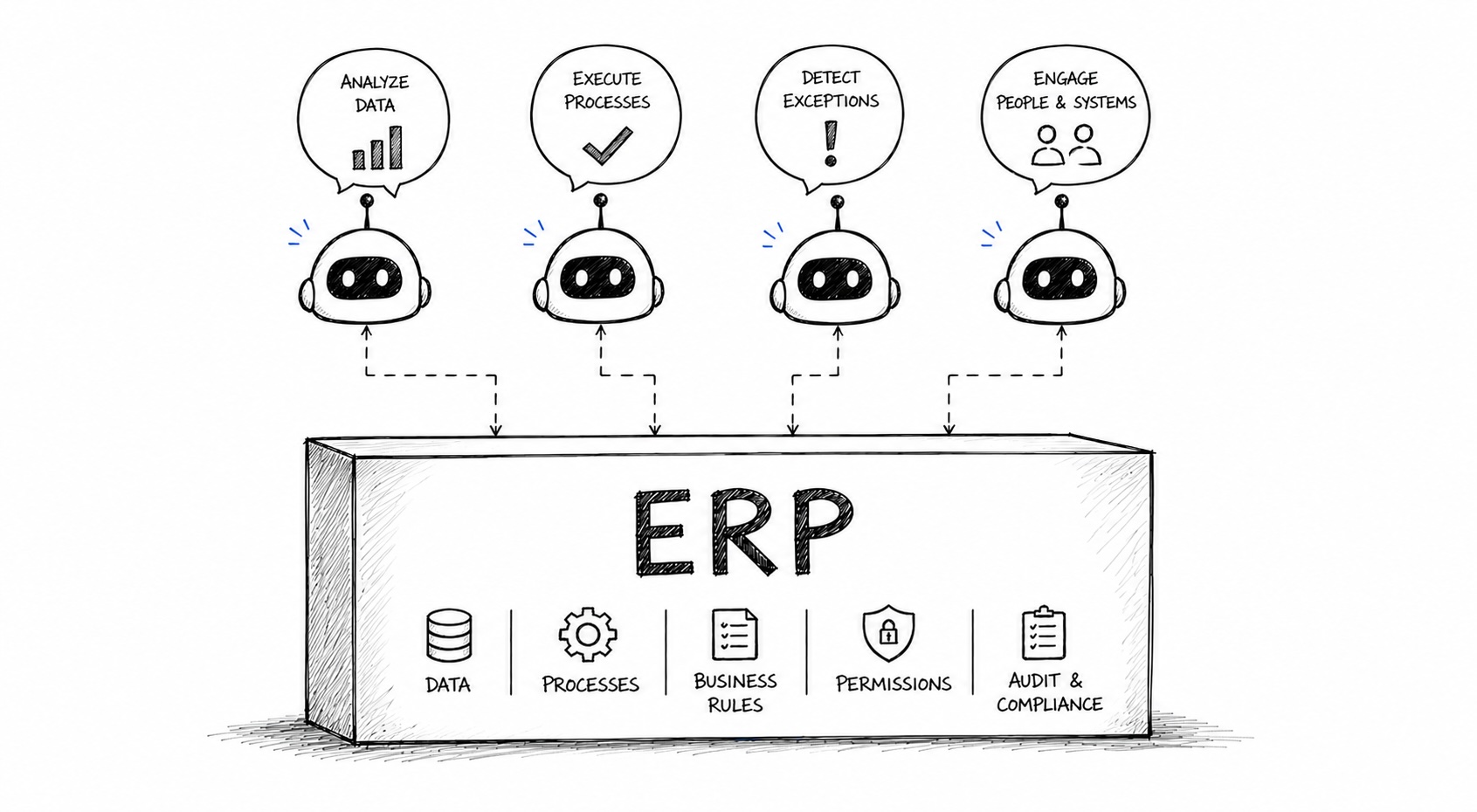
The major shift is that, in the future, the ERP may no longer be the main work interface for many users. People will not necessarily log into the system, navigate menus, fill out screens, click through multiple steps, and manually search for reports. Increasingly, they will interact with copilots, AI agents, conversational interfaces, automations, and intelligent workflows that will perform part of this work for them.
This does not mean the ERP becomes less important. In my view, the opposite happens. It may become even more important, but less visible.
The value of an ERP has never been only in the screen. For a long time, the screen was the required path to access that value. But the real value is in the data, business rules, processes, permissions, official records, and the ability to keep the company operating with control.
From system of record to system of action
When we talk about AI and agents inside companies, this point becomes even more important. An AI agent cannot create meaningful value in a large company by only answering generic questions or writing polished text. To be truly useful, it needs to understand the business context, access reliable data, know the processes, respect permissions, and, in many cases, execute actions inside corporate systems.
And this is where the ERP comes back to the center of the discussion.
For a long time, the ERP was mainly a system of record. It was where the company registered what had happened. A sale completed, a purchase approved, an invoice issued, a payment made, an item moved in inventory.
With AI agents, the ERP can also become part of a system of action. Not only recording what happened, but participating in the execution of what needs to happen. An agent can check an order, identify an inconsistency, recommend an action, open a request, update a record, trigger an approval, monitor an exception, or prepare an analysis for decision-making.
The interface changes, but the core remains essential.
The new criteria for choosing an ERP
This shift requires a different way of thinking about ERPs. In the future, choosing an ERP should not be only a decision about features, price, tax compliance, or implementation complexity. These factors will remain important, but they will not be enough.
The choice of an ERP will also depend on the system’s ability to serve as a foundation for a more automated, connected, and AI-oriented company.
An ERP prepared for this future needs to be open, well documented, secure, and easy to integrate. It needs strong APIs, events, audit trails, granular permissions, and the ability to interact with agents and external systems. A beautiful interface is not enough. A built-in copilot is not enough. Saying it uses AI is not enough.
The central question is different: does this ERP allow the company to compose its own intelligence layer?
The new intelligence lock-in
This question matters because many software vendors will try to position their own AI solutions as the complete answer. This can be useful in many cases. Native copilots inside corporate systems can accelerate tasks, improve user experience, and reduce operational effort.
But there is a risk: the new lock-in.
Historically, companies became locked into ERPs because of data, processes, and migration costs. In the next phase, they may also become locked into the intelligence layer. In other words, into the recommendations, agents, automations, decision models, and intelligent workflows controlled by the vendor itself.
This risk needs to be taken seriously.
A digitally mature company will not depend on a single agent, a single model, or a single AI provided by the ERP vendor. It will have agents built by internal teams, specialized market solutions, different models for different use cases, and integrations with several systems. The ERP needs to allow this composition. If it only works well with the vendor’s own AI, it may become a strategic bottleneck.
The ideal ERP for the future is not simply the one with the best embedded AI. It is the one that allows different agents to query data, respect rules, execute actions, and record everything with security and governance.
Security becomes action governance
This brings us to one of the most critical topics in this discussion: security.
Security in ERP is already important today. But in a scenario where multiple agents access data, create records, update information, and trigger actions, it becomes even more fundamental.
The problem is no longer only “who can see this data?”. The question also becomes: who can execute this action? Which agent can update this field? In what situation? With what approval? Within what limit? Based on what evidence? How will this be audited? How can an incorrect action be reversed? How do we avoid segregation-of-duties conflicts? How do we ensure that an agent cannot do something a human user would not be allowed to do?
In the age of agents, security needs to evolve from access control to action governance.
This may be one of the biggest changes. Because agents are not just a new interface. They can become active participants in the operation. And when a system starts to act, controlling information is not enough. It is necessary to control decisions, execution, responsibility, and traceability.
Bad data scales bad problems
There is also a less glamorous, but perhaps even more important, point: the quality of data and processes.
Many companies want to talk about AI, agents, and automation, while still dealing with duplicated master data, inconsistent records, processes outside the system, approvals by email, parallel spreadsheets, and exceptions that no one documents. In this context, adding AI on top of the process does not solve the problem. It may only automate the mess.
Agents on top of bad data do not create intelligence. They scale errors.
That is why, before imagining autonomous agents making complex decisions, many companies will need to do the basic work: clean data, review master records, organize permissions, digitalize processes, expose APIs, reduce invisible exceptions, and clearly define who owns each process.
A company’s AI maturity will not be measured only by the model it uses. It will be measured by the quality of its operational foundation.
And this foundation is not only technological. It involves processes, governance, culture, responsibilities, and management discipline.
ERP as an operational foundation
This is why I believe ERPs will remain extremely relevant. Not necessarily because every user will spend the whole day inside them, but because large companies need reliable systems to record, control, audit, and orchestrate critical processes.
The more a company wants to use AI agents in important processes, the more it will need a solid base where those agents can find information, understand rules, and execute actions safely.
The ERP does not need to be the only system in this architecture. In practice, the real process of a company may be distributed across ERP, CRM, legacy systems, data lakes, customer service tools, workflow platforms, BI, and even spreadsheets. But the ERP will remain one of the main transactional backbones of the organization.
The ERP discussion, therefore, is no longer just a back-office discussion. It becomes a strategic decision about the company’s intelligence architecture.
What leaders need to ask now
Technology and business leaders will need to look at their current ERPs and ask different questions. Is the system ready for agents? Is the data reliable? Are the APIs strong enough? Are the processes truly digitalized? Are permissions granular? Are actions auditable? Does the ERP allow integration with external agents? Or will the company become dependent on the vendor’s own AI?
These questions will become increasingly important.
In my view, the future of ERPs will not be defined by who creates the best screen. The interface will continue to exist, but it will lose prominence in many operational tasks. What will really matter is the ERP’s ability to work as a secure, open, and governed foundation for humans and agents to operate together.
The ERP of the future will be less about navigating screens and more about operational trust. Less about clicks and more about executable processes. Less about being the only place where users work and more about being the base where the company records, validates, executes, and audits its decisions.
The ERP will not disappear. It will become infrastructure for a more intelligent company. And, in this new scenario, the winning ERPs will not be only those that have AI. They will be those that allow the company to build its own intelligence on top of a solid, open, secure, and reliable foundation.